
Night predator calling setups
Stand setup, wind, getting in quietly, and shooter and light-holder teamwork.
Set up where you can see the approaches, with the wind in your face or quartering across so you can watch the downwind side. Get in quietly with little light, then scan with a wide, dim beam while you call. With two hunters, one runs the light and one stays on the gun; raise the brightness only when the animal is close enough to identify, and don’t shoot until it is positively identified.
Before you go
Confirm what your state allows at night; see night hunting laws and safety.
Get the landowner’s permission and agree on where you can hunt and shoot.
Scout in daylight: pick stands and quiet approach routes, and note houses, roads, livestock and safe backstops.
Charge your batteries and bring a spare.
Pick the stand
Choose a spot with a clear view of the ways an animal is likely to come in, with cover behind you to break up your outline. Every shooting lane needs a safe backstop, and you should know exactly where buildings, roads and livestock are before it gets dark.
Play the wind
Predators often try to circle downwind to scent-check a sound before they commit. Set up with the wind in your face or quartering across, so the downwind side is somewhere you can see and cover with the light.
Get in quietly
Walk in with as little light as you can safely use, and don’t sweep the stand area with a bright beam before you sit. Red makes a great utility light for walking to your stand and gathering gear.
Shooter and light holder: working as a team
With two hunters, split the jobs:
Light holder scans with a wide, dim beam (the edge of the beam, not the hot spot), calls out eyes and direction, and keeps the light steady.
Shooter stays on the gun and follows the light holder’s calls.
Agree on simple words before you sit: “eyes,” the direction, “on it,” “hold,” “clear.”
When eyes are close enough, the light holder raises the brightness gradually with Intensity Control (adjustable brightness) and tightens the beam.
The shooter confirms the animal through the scope; only the shooter decides whether to shoot.
The light holder keeps the beam on the animal through the shot and after, to help with recovery.
Safety
Set each person’s shooting lanes before you call, and never swing a muzzle past your partner. If either of you isn’t sure what the animal is or what’s behind it, don’t shoot.
Hunting solo
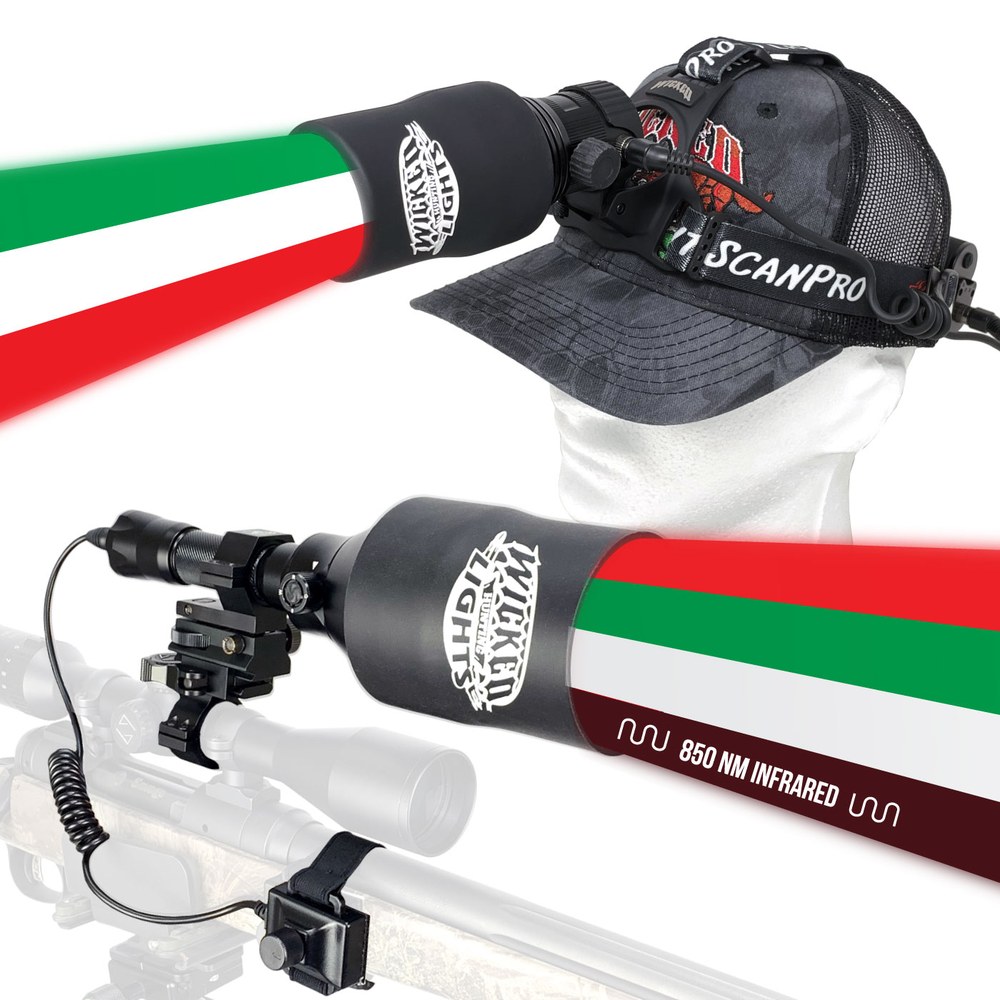
Solo, many hunters scan hands-free with a headlamp and take the shot with a scope-mounted light. The headlamp can also act as a shield against the eyes of an approaching animal that would otherwise see you standing there. The A75iC + ScanPro iC Gen 4 3-Color-In-1 combo kit pairs the A75iC 4-Color-In-1 hunting light with the ScanPro iC Gen 4 3-Color-In-1 headlamp.
__FIG:combo-green.jpg|A75iC 4-Color-In-1 hunting light and ScanPro iC Gen 4 3-Color-In-1 headlamp (combo kit)|a75ic-green.jpg|A75iC 4-Color-In-1 on a scoped rifle__
Zero the hunting light before the hunt; see mounting a light on a rifle, shotgun or bow.
Light color on a calling stand
Red for bobcat, fox and other light-shy predators and for close setups, green for coyotes, hogs and big fields, and IR with night vision when you don’t want a visible beam. A multi-color light lets you switch on the stand without swapping LEDs. Full breakdown: the red vs. green vs. white vs. infrared light color guide.
After the shot
Keep the light on the spot where the animal was, and note a landmark before you move. White is the best color for recovering animals. Approach carefully, and keep your partner informed of where you are going.
More setups and technique: Night Hunting 101.
FAQ
What color light is best for night coyote calling?
Green is a common pick for coyotes and big fields; red is the go-to for light-shy predators and close setups. Many hunters carry both, which a multi-color light makes easy.
How should a shooter and light holder work together?
The light holder scans dim, calls out eyes and direction, and raises the brightness only when the animal is close enough to identify. The shooter stays on the gun, confirms the animal through the scope, and alone decides whether to shoot.
Can I night hunt predators alone?
Yes, if your state allows it. Many solo hunters scan with a headlamp and take the shot with a scope-mounted light, such as the A75iC + ScanPro iC Gen 4 3-Color-In-1 combo kit.
Where should I set up relative to the wind?
With the wind in your face or quartering across, so the downwind side, where predators often circle, is somewhere you can see and cover with the light.
Keep reading
Lights in this article
*Identification range and eye shine are estimates based on in-field use and customer feedback: identification through quality optics (for IR, through a quality digital night vision device). Candela and beam throw are measured following the ANSI/PLATO FL 1 Standard, from a lux reading at 7 yards. Optics, moon phase, weather, battery charge and the animal all affect real-world range.


Comments