
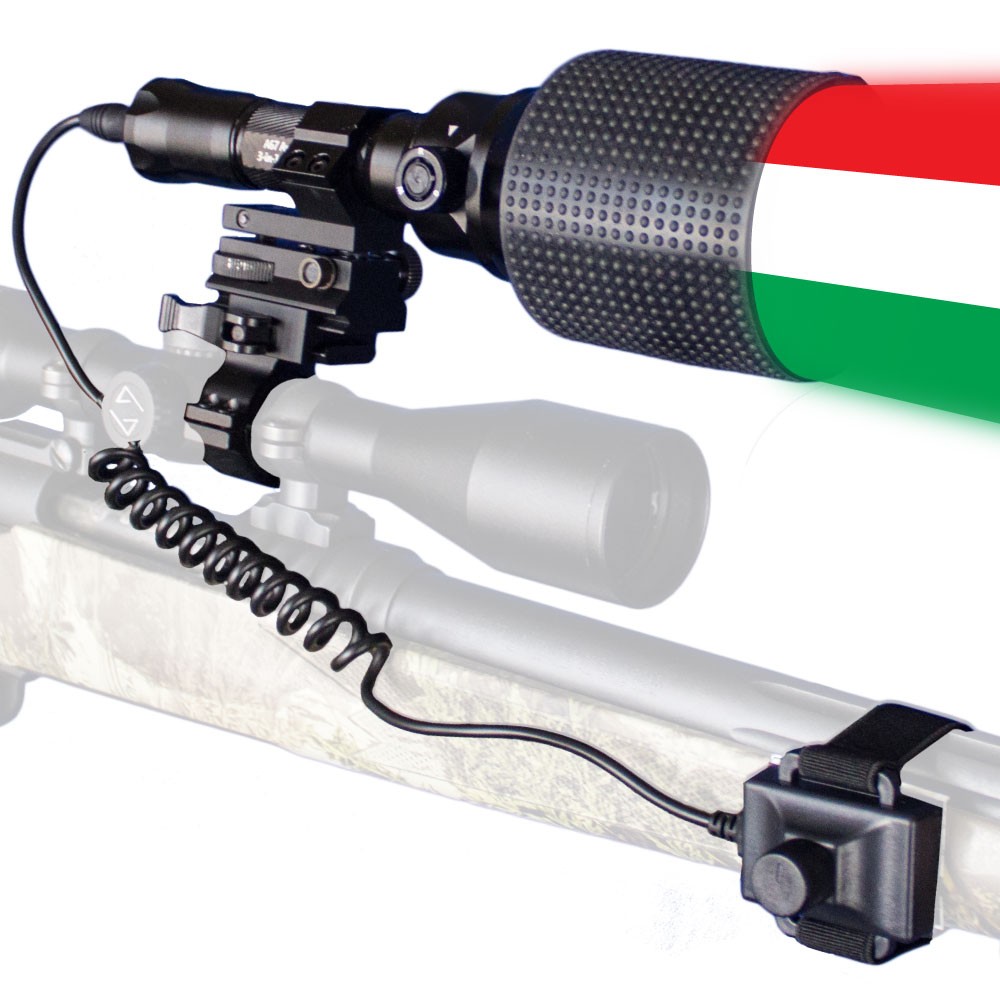
Red vs. green vs. white vs. infrared: which hunting light color?
Which color for which animal and conditions, and why one light with several colors helps.
Use red for light-shy predators (Wicked Lights recommends red for bobcat and fox) and close-range setups, green for hogs and coyotes or for scanning big fields at long distance, and white for the longest identification range, varmints and recovering game. Use infrared (850nm or 940nm) with night vision when you don’t want a visible beam. A patented multi-color light carries several colors in one light, and you switch with a twist of the knob.
Quick guide: which color for which situation
Color | Best for | Keep in mind |
Red | Bobcat and fox (Wicked’s recommendation) and other light-shy predators, a small pasture, or a feeder or bait pile at close range | Also a great utility light. With night vision, digital devices only. |
Green | Hogs and coyotes, or scanning big fields at long distance | Identification range differs by model; check each one. |
White | Raccoons, alligators and other varmints, filming at night, recovering animals, utility work, and the longest identification range | Start low with Intensity Control (adjustable brightness) and raise it gradually. |
850nm IR | Night vision hunting with no visible beam; reaches farther than 940nm | The emitter gives off a faint red glow when you look straight at the light. |
940nm IR | Closer-range night vision hunting, such as hogs over a feeder or coyotes over bait | Very low emitter glow, with less range than 850nm. |
Color is one part of the decision; range, runtime and mount are the others. See how to choose a night hunting light.
Red light
For bobcat and fox, Wicked Lights recommends red. Red is the go-to for light-shy predators and for close-range setups like a small pasture, a feeder or a bait pile. It is also a great utility light for walking to your stand, gathering gear or finding downed game. On most Wicked multi-color lights, red identifies at a shorter range than white; check the model on Compare.
Green light
Green is the common pick for hogs and coyotes, and for scanning big fields at long distance. Many predator hunters carry both red and green and decide on the stand, which is where a multi-color light pays off. For stand setup and light work on a calling stand, see night predator calling setups.
White light
White gives the longest identification range on most Wicked lights. Use it for raccoons, alligators and other varmints, filming at night, recovering animals and utility work. Because white is the brightest option, Intensity Control (adjustable brightness) matters most here: start low and bring it up only as far as you need to identify the animal.
Infrared: 850nm vs. 940nm
Infrared (IR) is invisible to the naked eye; you use it with a digital or traditional night vision device. 850nm reaches farther and is the best all-around choice when you don’t want a visible beam, but the emitter gives off a faint red glow you can see when looking straight at the light. 940nm has very low emitter glow, so it suits closer-range hunting like hogs over a feeder or coyotes over bait, with less range.
Night vision caution
On the A67iR and A51iR, use the Red LED with digital night vision only, with a small dust-cover aperture and the contrast and gain set to avoid washout. Red is too bright for military-grade (Gen 3) night vision and can damage it.
The A67iR and A51iR carry 850nm IR, 940nm IR and Red in one light, and the A75iC 4-Color-In-1 has an 850nm IR LED built in. See all infrared night hunting lights.
Why one light with several colors: the patented multi-color story
Wicked Lights is the original developer of the multi-color hunting light. A patented internal rotation mechanism (US Patents 9,951,928, 10,208,924 and 11,028,998) turns each LED into the center of the light, behind the lens, and locks it there. You get full brightness from every color, no point-of-aim shift when the light is mounted, and no bulbs to swap: you change colors with a twist of the knob.
Some other lights make you take the light apart to swap an LED module. Others put several LEDs side by side, so the active color sits off center, loses brightness and shifts the beam. Wicked multi-color lights focus their light through a magnifying lens, and the lens gets the most out of an LED when it sits on the lens’s axis, which is why each color is rotated to the center.
__FIG:a67ic-hand-scan-kit-thumb-2026.jpg|A67iC 3-Color-In-1 Hand Scan Kit: three colors in one light|combo-green.jpg|A75iC 4-Color-In-1 hunting light and ScanPro iC Gen 4 3-Color-In-1 headlamp__
The design is on the A67iC 3-Color-In-1 and A51iC 3-Color-In-1 bow light, the A75iC 4-Color-In-1, the A67iR and A51iR 3-LED-In-1, and the ScanPro iC Gen 4 3-Color-In-1 headlamp.
Whatever the color, start dim
Every current Wicked light has Intensity Control (adjustable brightness). Set the brightness before you turn the light on, start low, and raise it gradually until you can positively identify the animal. Animals notice a slow increase less than being suddenly hit with a bright beam, so you spook fewer of them. For scan technique and how to read eyes in your beam, see scanning and identifying eye shine.
Which Wicked lights have which colors
Light | Colors |
A75iC 4-Color-In-1 | Green, Red, White and 850nm IR, built in |
A67iC and A51iC 3-Color-In-1 | Green, Red and White, built in |
A67iR and A51iR 3-LED-In-1 | 850nm IR, 940nm IR and Red, built in |
ScanPro iC Gen 4 3-Color-In-1 | Green, Red and White, built in |
ShotPro, W404iC, A55iC | One color at a time: Green, Red, White or 850nm IR; other LED modules sold separately |
ScanPro iC Gen 4 (single-color) | One color at a time: Green, Red or White |
More guides on choosing, mounting and using your light are in Night Hunting 101.
FAQ
What color light is best for bobcat and fox?
Red. Wicked Lights recommends red for bobcat and fox. Red is also the go-to for other light-shy predators and for close-range setups.
What color light is best for coyotes?
Green is a common pick for coyotes and for scanning big fields at long distance. Red is the go-to for light-shy predators and close-range setups. Many hunters carry both, which a multi-color light makes easy.
What color light is best for hogs?
Green is the common pick for hogs. If you hunt hogs over a feeder with night vision, 940nm IR has very low emitter glow at closer range.
Can I use the red LED with night vision?
With digital night vision only, with a small dust-cover aperture and the contrast and gain set to avoid washout. Red is too bright for military-grade (Gen 3) night vision and can damage it.
Does changing colors shift my point of aim?
Not on a Wicked multi-color light. Every LED locks into the same center position, so the beam stays centered in your crosshairs. Zero the beam once with the Gen 4 adjustable mount, then switch colors without re-zeroing.
Keep reading
Lights in this article
*Identification range and eye shine are estimates based on in-field use and customer feedback: identification through quality optics (for IR, through a quality digital night vision device). Candela and beam throw are measured following the ANSI/PLATO FL 1 Standard, from a lux reading at 7 yards. Optics, moon phase, weather, battery charge and the animal all affect real-world range.


Comments