
Scanning and identifying eye shine
Scan technique, reading eye spacing and movement, and positive identification before the shot.
Scan slowly with a wide, dim beam and watch for pairs of reflected eyes, then read their spacing, height and movement. When you have eyes, raise the brightness gradually and tighten the beam to identify the whole animal through your optics. Never shoot at eye shine alone: confirm the animal and what is behind it first.
What eye shine is
Many animals that are active at night have a reflective layer at the back of the eye that bounces light back toward its source. That is why eyes light up in your beam long before you can make out the animal’s body. The reflection is strongest when the light sits close to your line of sight, which is one reason a headlamp or a scope-mounted light works well for spotting eyes.
How to scan
Set a wide beam. Turn the bezel (or the rear spot-to-flood control on the W404iC and ShotPro) to flood so you cover more ground with less chance of spooking the animal.
Start dim. Set Intensity Control (adjustable brightness) low before you turn the light on.
Sweep slowly. Work field edges, fence lines, draws and brush lines, and pause; eyes that are moving or partly hidden take a moment to show.
Use the edge of the beam. Many hunters scan with the outer part of the beam rather than putting the bright center directly on an animal.
Hold steady on eyes. When you pick up a pair, keep the light low and steady and let the animal settle or come closer.
__FIG:handgrip-in-hand.jpg|Scanning in your hand: A67iC 3-Color-In-1 Hand Scan Kit|scanpro3-green.jpg|Scanning hands-free: ScanPro iC Gen 4 3-Color-In-1 headlamp__
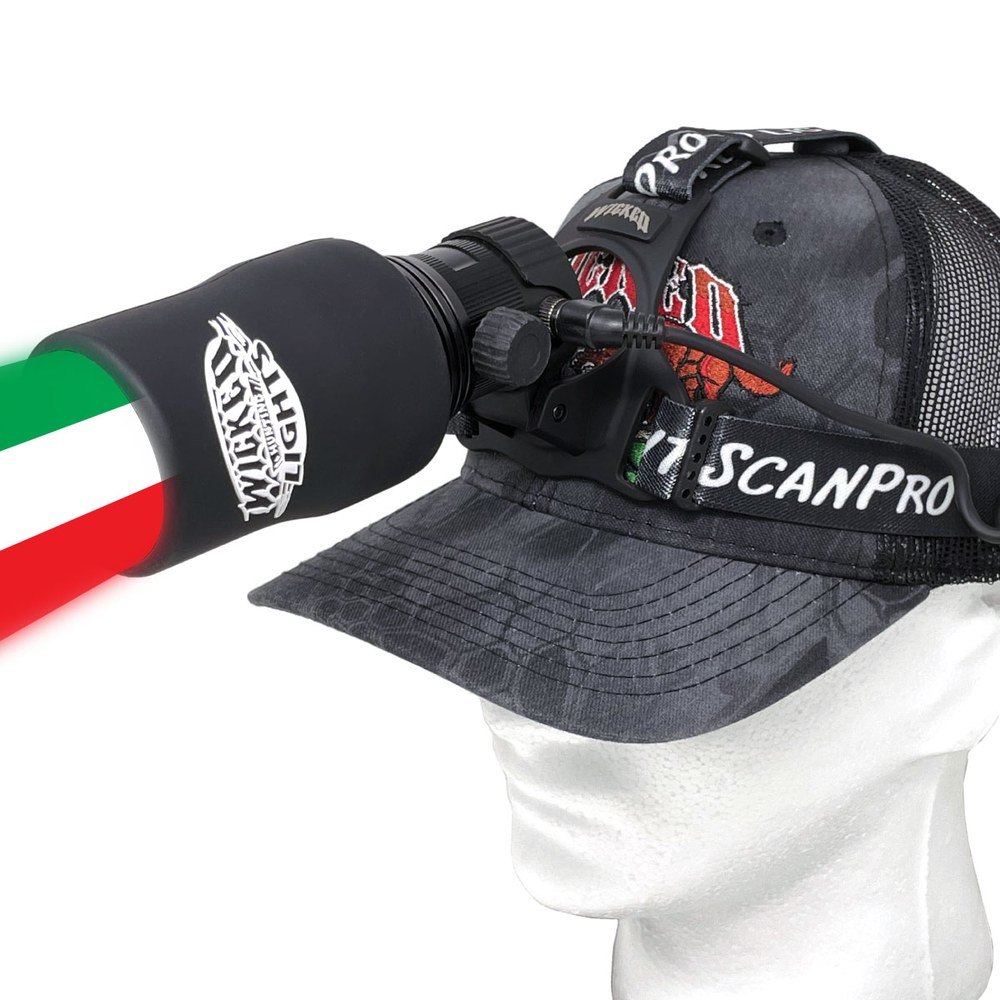
A headlamp like the ScanPro iC Gen 4 3-Color-In-1 headlamp lets you scan hands-free and keep your hands on the gun; the A67iC 3-Color-In-1 Hand Scan Kit is built for scanning in your hand.
Reading the eyes: spacing, height and movement
Spacing: wider-set eyes generally mean a larger head. Compare against animals you already know in your area.
Height: how far the eyes sit off the ground helps separate a small predator from a deer or livestock.
Movement: watch how the eyes travel: a steady approach, a bounce, or circling to get downwind.
Number: count pairs; animals often travel together, and livestock may be bunched.
Color: eye-shine color changes with your light color, the angle and the distance, so don’t identify an animal by eye color alone.
The light color you scan with matters too; see the red vs. green vs. white vs. infrared light color guide.
Eye shine distance vs. identification range
You will see eyes well beyond the distance at which you can identify the animal. For example, the A67iC 3-Color-In-1 has estimated eye shine at 600+–700+ yards* but an identification range of ~325–375 yards* through quality optics; the A75iC 4-Color-In-1 shows eye shine at 700+–800+ yards* and identifies to ~400–450 yards*. Expect to wait for the animal to close the distance before you can confirm what it is.
Estimated identification range and eye shine for every model are in how to choose a night hunting light.
Positive identification before the shot
When the animal is within your light’s identification range, raise the brightness gradually with Intensity Control (adjustable brightness) and tighten the beam toward spot. Through your optics, confirm:
the species, from the whole body, not just the eyes;
that it is not livestock, a pet or a person;
what is behind and beyond the animal, so you have a safe backstop.
If you can’t confirm all three, don’t shoot. More on this in night hunting laws and safety, and more technique guides in Night Hunting 101.
FAQ
How far away can you see eye shine?
It depends on the light, color and conditions. Wicked Lights publishes estimated eye-shine distances: for example 800+–900+ yards* for the ShotPro and 700+–800+ yards* for the A75iC 4-Color-In-1.
Why can I see eyes but can’t tell what the animal is?
Eyes reflect your light from much farther away than you can identify the body. Identification range through quality optics is shorter than eye-shine distance on every model, so wait for the animal to come closer.
Should I scan with a headlamp or the hunting light?
Many night hunters scan hands-free with a headlamp, then take the shot with a scope-mounted light. The headlamp can also act as a shield against the eyes of an approaching animal that would otherwise see you standing there.
Can I identify an animal by its eye color?
Not reliably. Eye-shine color changes with your light color, the viewing angle and the distance. Use spacing, height and movement to decide what to watch, then identify the whole animal through your optics before you shoot.
Keep reading
Lights in this article
*Identification range and eye shine are estimates based on in-field use and customer feedback: identification through quality optics (for IR, through a quality digital night vision device). Candela and beam throw are measured following the ANSI/PLATO FL 1 Standard, from a lux reading at 7 yards. Optics, moon phase, weather, battery charge and the animal all affect real-world range.


Comments